
Saint Paul Bread Club
We knead to bake!
Page Menu
Other Links:
Oven Sources
Last revised 07/06/2013.
There are basically two ways to acquire an oven.
- Build it yourself.
- Buy it from an oven builder.
I am going to focus this page on sources in Minnesota and Wisconsin, since that is where I’m writing from.
For sources in other states (and around the world), look at the Oven Component Suppliers link page.
Build It Yourself
If you decide to build it yourself, you have to decide if you are going to build a brick oven or a clay oven.
You have to decide if you are going to take a class on oven building or not.
You have to decide where you are going to get your plans for building your oven.
Classes on Oven Building
I’m going to focus on classes near the Twin Cities (St. Paul/Minneapolis). If you know of any oven-building classes, I’m always happy to link to them. Just send me an e-mail, and I will add the class to this list.
I have collected as many links to oven-building classes as I can find. Some of these links are for past classes, but they are there so that there is some record of the organizations that offer such classes.
Brick Ovens - North House Folk School
In Minnesota, we are blessed to have the North House Folk School where they have classes on building brick ovens.
The good news is they have multiple classes a year. The bad news is that the classes fill up quickly, the tutition is about $445 (plus $20 for materials) for the four and a half days, and you have to travel to and stay up north to take the class.
That’s a major investment in time and money, but so is building a brick oven.
Brick Ovens - Elsewhere
For the last couple of years, people near the Twin Cities have sponsored classes at their own homes in order to get help building their brick ovens. They hire the same instructor used by North House to come down and teach the class.
I link to these oven-building classes when I find them.
Cob Ovens
For building clay (or cob) ovens, we have fewer resources.
I am especially interested in cob oven classes, so if you find any around the Twin Cities of Minnesota, please let me know.
Gale Woods Farm
There was a class at Gale Woods Farm in their own folk school for building cob ovens in the summer of 2008, and another in 2009. There have not appeared to be any cob oven classes since then.
Driftless Folk School
I was pleased to discover the Driftless Folk School.
They have a class called “Building an Earthen Oven” that had two sessions in 2010. One was in Decorah, Iowa, and the other in Viroqua, Wisconsin.
In 2011, they had another cob oven class on June 26 (near Hillsboro, WI).
In 2012, they had another cob oven class on June 23.
Stacked-brick Ovens
For building stacked-brick ovens (also known as portable brick ovens or 1-hour brick ovens) there is only one person who teaches such a class, me. The class runs almost a full day, but you learn to build the ovens, see demonstrations of recipes to bake in the ovens, and you get to eat food fresh out of the oven.
For the current schedule of classes on building stacked-brick ovens, see portable classes.
Silverwood Park
Silverwood Park was the home of the first stacked brick oven class, on Saturday, March 20, 2010, from 9am to 3pm. (This class had ten people, a waiting list, and people calling the day of the class to see if they could get in, so there is obviously some interest in the subject.)
There have been other classes there, for example, on Sept. 10, 2011, and April 28, 2012.
I recently (May, 2012) received an e-mail from the park supervisor saying that Silverwood Park thought my class didn’t fit into their mission, so they would no longer offer my class there. My class moved to Gale Woods Farm Park (see below) for a class on Sept. 8, 2012.
French Hill Folk School
There was a class at the French Hill Folk School, part of the Borner Farm Project in Prescott, Wisconsin, on June 12, 2010. We had five people in the class, and at least one oven has been built by one of the students of that class.
Another class was held on August 14, 2010, also at Borner Farm. That class had nine people, including someone from Hawaii and someone from Missouri.
Driftless Folk School
In 2011, they had my portable brick oven class a couple of times, on June 25 and October 8 (near Soldier’s Grove, WI).
Borner Farm Project
There was a class as part of the Borner Farm Project in Prescott, WI, that they called Building and Baking! Brick Oven Basics.
This class was on June 16, 2012.
Gale Woods Farm Park
Stacked brick ovens returned to Gale Woods Farm Park in the form of a class there on Sept. 8, 2012.
Your Very Own Class
If you are interested in hosting a class on stacked-brick ovens, send me an e-mail, and we can see if we have any compatible dates available. (You will be responsible for supplying the bricks with which to build one or more ovens; I have neither the bricks nor the means to transport them.)
Here is a page with the basic requirements for hosting a class.
If you can get enough students signed up, you can use your share of the class fee to help pay for the bricks needed to build your oven.
Books on Oven Building
For books on oven building, the two main resources seem to be The Bread Builders: Hearth Loaves and Masonry Ovens and Build Your Own Earth Oven : A Low-Cost, Wood-Fired Mud Oven; Simple Sourdough Bread; Perfect Loaves (one for brick and one for clay ovens).
There are other oven building books listed on the Brick Oven Links page.
Internet Resources for Oven Building
Each of the books has a related web site.
- Alan Scott - OVENCRAFTERS (related to the book, The Bread Builders)
- Kiko’s Page (related to the book, Build Your Own Earth Oven)
- Forno Bravo (source for a free e-book on building a Pompeii oven)
There are a myriad of other sites; you can start by looking at the Oven Links page for more information.
Buy It From An Oven Builder
There are a few Minnesota sources for buying ovens.
Note that these are companies that I am aware of, but not a customer of. I have no experience buying or using their products, and therefore I cannot make any statements about the cost or quality of the ovens any of them supply.
These companies sell many things besides ovens, so don’t be surprised if you have to look around (or call around) to get information on the kinds and prices of ovens.
Prebuilt Ovens
You can get prebuilt ovens from:
- Artesian Ovens - prefabricated refactory concrete dome ovens
- Infinity Ovens - alternative site for prefabricated refactory concrete dome ovens
- Lorenzo’s Ovens - imported wood-fired ovens
- Woodland Stoves & Fireplaces - a wide variety of prefabricated ovens
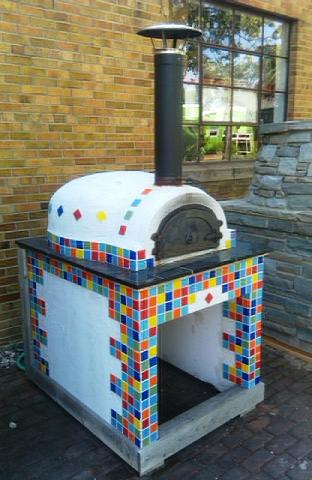
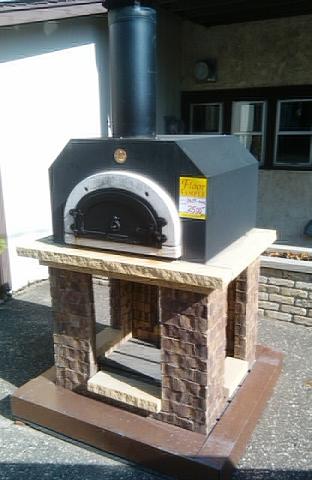
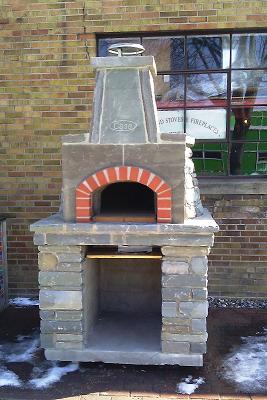
Here are some pictures of ovens available from Woodland Stoves.
Ovens Resold by Major Companies
You can get ovens (and much more) from:
- Custom Retaining Walls and Landscaping, Inc.
- Hedberg Landscape and Masonry Supplies
- Outdoor Environments, Inc.
- Rochester Concrete Products (resells FireRock ovens)
- Stoneman Masonry, Inc.
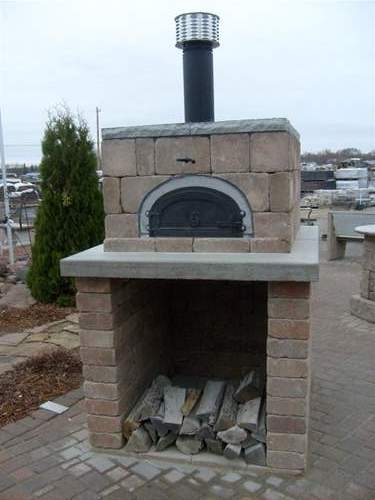
Photo of Custom Retaining Walls and Landscaping, Inc. oven, used with permission.
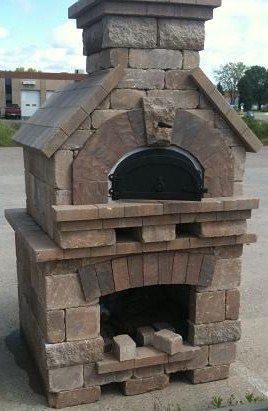
Photo of Hedberg Landscape oven by Terry Savoie and used with permission.
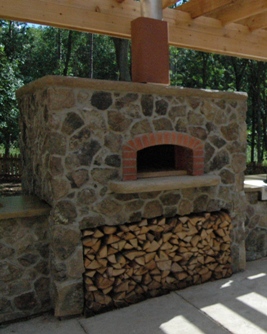
Photo of Outdoor Environments oven used with permission.
From what I have seen, these companies resell ovens built by other companies (such as Chicago Brick Oven).
Some of these designs are going to be better than others. You might not be able to tell how well they are designed or how they work without seeing one in action.
Ovens Built at North House Folk School
They sometimes auction off the oven cores built by their classes.
You might be able to get a partially built oven from North House Folk School, but you will have to pay to have it delivered to wherever you want it to go, plus build a base for it and then the oven insulation and exterior.
Ovens Built by Individuals
You should also note that sometimes people have hired individual masons to execute the plans for ovens acquired through the internet. I don’t have the names of those masons. (But if you do, you could let me know, and I’ll share.)
Grant Johnson
I do have contact information for an oven builder in British Columbia, Canada:
Grant Johnson
Oven Builder/Artisan Baker
Cawston, BC
V0X 1C1
250-499-5985
250-499-1012
hearthandhand@yahoo.com
Jesse Stevens
I also have contact information for an oven-builder in Sweden, Maine:
He says, “I build both cob and brick ovens, residential and commercial.”
Jesse Stevens
338 Bridgton Rd
Sweden, ME 04040
207-647-5368
stesse57@hotmail.com
Ovens Built by Me
I have built stacked-brick ovens as part of my classes and my own experiments. If you think that this kind of oven will meet your needs, and you can’t wait to take one of my classes, I can build it for you.
Here’s a link to a description of their features.
Note that these ovens are temporary, in the sense that they are not made with mortared brick. I consider this to be an advantage because you can easily move them if they are in the wrong place, and you can make them bigger or smaller if they are the wrong size. (Also, since they are temporary, they don’t require building permits.)
These ovens are faster to build than mortared brick ovens and even cob ovens. They are also cheaper than more traditional brick ovens by a significant amount.
If you are interested in seeing how a stacked-brick oven might meet your need for a wood-fired oven, send me an e-mail.